A grade on a magnet quote tells you something about the material. It does not, by itself, tell you how much force the finished part will produce or what field a sensor will measure. The label is most useful when you know which material family it belongs to and can compare the properties, dimensions, and operating conditions that matter to your design.
That distinction avoids a specification mistake: treating grade numbers from different materials as rungs on one strength ladder. An NdFeB N-number, a ferrite designation, and an Alnico grade belong to different naming systems. Compare the datasheet fields and the magnet in its intended circuit, not the numbers in isolation.
What a Magnet Grade Tells You and What It Doesn’t
A magnet grade is a material designation used to identify a particular set of magnetic characteristics within a material family or supplier’s catalog. It is a starting point for comparing candidate materials. It is not a complete part specification, and “higher grade” does not automatically mean “better for this application.”
Maximum energy product can help when assessing a material for a design, but it does not by itself tell you how much material a finished part needs. A design may instead be constrained by resistance to demagnetization, temperature, available space, magnetization direction, or the shape of the magnetic circuit. Those requirements change which properties matter most.
To compare candidates, first identify the material family and the exact maker’s designation. Then compare named properties under stated conditions. If a supplier uses a suffix or a house-specific code, ask for its definition rather than borrowing a key from another catalog.
The Datasheet Numbers Behind the Label
Four fields help describe a permanent magnet’s magnetic material. They are related, but they do not measure the same thing. Arnold’s technical note, Measuring the Magnetic Properties of Permanent Magnets, defines these terms and explains why measured values depend on the measurement and magnet context.
| Datasheet field | What it describes | What it does not tell you by itself |
|---|---|---|
| Br: remanence or residual flux density | The magnetic flux density remaining after the material has been brought to saturation and the applied field is removed. | The field at an arbitrary point around a finished part. |
| HcB: coercive field strength | The reverse magnetic field at which flux density B reaches zero on the normal demagnetization curve. | The material’s full resistance to irreversible demagnetization. |
| HcJ: intrinsic coercivity | The reverse field at which intrinsic polarization J reaches zero; it is used to describe resistance to demagnetization. | A guarantee that the magnet will remain unchanged under every temperature and circuit condition. |
| (BH)max: maximum energy product | The largest product of B and H on the material’s demagnetization curve, a measure used to compare magnetic energy product. | Pull force, field at a sensor, or finished-assembly performance. |
Use the units and test conditions printed on the specific data sheet. Flux density may be shown in tesla or millitesla; field strength may be shown in A/m, kA/m, or another stated unit. A value without its unit, material designation, and applicable conditions is not a safe basis for a comparison.
A manufacturer’s grade table can help narrow candidates, but it is not a substitute for the current data sheet tied to the exact material and part. Arnold’s NdFeB catalog lists properties such as Br, HcB, HcJ, (BH)max, temperature coefficients, and maximum-temperature fields by grade. The catalog also notes that properties can vary with alignment direction, size, and shape. For an actual design decision, request the applicable product data and confirm the measurement conditions.
How Common Magnet-Family Labels Differ
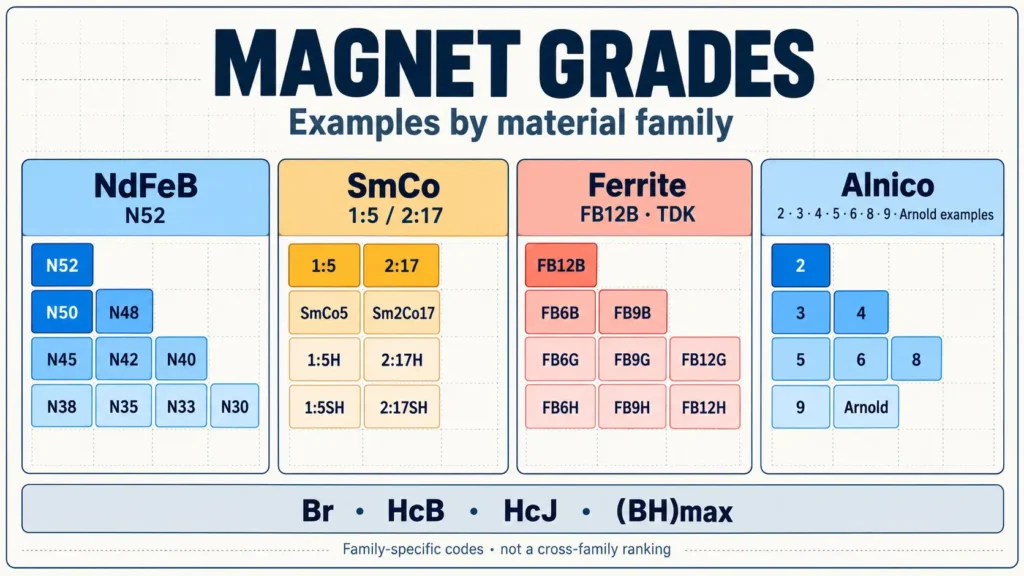
Magnet grades are family-specific. These examples show how to read a label without implying that the codes share one numbering scale.
| Family | Example of how a designation appears | What to verify |
|---|---|---|
| NdFeB (neodymium-iron-boron) | A grade such as N52 belongs to an NdFeB grade series. A maker may append additional characters to a designation. | Confirm the maker’s full code and compare its listed Br, HcB, HcJ, (BH)max, temperature data, and magnetization direction. Do not assume a suffix has the same meaning across suppliers. |
| SmCo (samarium-cobalt) | Manufacturer literature distinguishes 1:5 and 2:17 SmCo material families. | Treat the family label as the beginning of the lookup. Use current, grade-specific product data for properties and operating limits; older family-level summaries are not a substitute. |
| Ferrite | TDK lists the ferrite product FB12B in its FB12 series. | Use the product record or current data sheet for the values associated with that exact designation. Do not read “12” as a cross-family strength score. |
| Alnico | Arnold lists numbered examples including grades 2, 3, 4, 5, 6, 8, and 9. | Arnold describes grades 2, 3, and 4 as unoriented/isotropic and grades 5, 6, 8, and 9 as anisotropic, with a preferred output direction. Confirm the maker’s data and required orientation. |
Sources for the examples: Arnold’s NdFeB catalog, Arnold’s SmCo technical note, TDK’s FB12B product record, and Arnold’s Alnico overview. The SmCo note is a 2015 revision; use it here only for the 1:5 / 2:17 family distinction, not for current numeric comparisons or operating recommendations.
Temperature-related letters deserve particular care. Do not infer an allowable operating temperature from a grade suffix alone. Check the suffix definition and the maker’s stated maximum-temperature or temperature-coefficient data for that exact grade. The part’s operating conditions and magnetic circuit still matter.
Some specifications are standardized within a defined scope. The IEC listing for IEC 60404-8-1:2023 says the standard specifies minimum values for principal magnetic properties and dimensional tolerances for technically important permanent-magnet materials. That public abstract does not establish that every commercial grade code is interchangeable or that a particular product conforms. For compliance or equivalence, confirm the applicable material, standard edition, and requirements against the relevant documentation.
Why Grade Is Not Pull Force or Gauss at Your Application
A material property describes the magnet material under defined conditions. A field reading describes the field at a particular location and orientation. Pull force describes the force in a particular test setup. Performance in an assembly depends on the magnet as a part of a magnetic circuit. These are different questions, so one cannot be substituted for another.
A grade table cannot tell you the field at a sensor a specified distance away. Nor does Br alone give the pull force of a finished component. Part dimensions and shape affect an individual magnet’s behavior; the surrounding steel, air gap, orientation, temperature, and return path affect what the assembled system does. Arnold’s measurement note distinguishes material properties from properties of an individual magnet, while its NdFeB catalog flags geometry and alignment as relevant to listed properties.
Interpret a supplier’s pull-force figure alongside its test setup. At minimum, check the magnet dimensions and orientation, the steel target and its thickness, the contact condition, and the measurement method. If your application has a gap, coating, curved surface, sensor, or moving component, ask for the performance measure that matches that real arrangement. A catalog value from a different setup may be a poor proxy.
A gauss reading is not a universal strength score unless you know what was measured, where the probe was placed, and under what geometry and conditions. When comparing candidate magnets, use the property that answers the design question: a material property for material screening, and a specified field or force measurement for the part or assembly requirement.
A Grade-Check List for a Drawing or RFQ
To make supplier responses comparable, include the conditions that can change the answer. For each candidate, request or specify:
- Material family and exact designation. Name NdFeB, SmCo, ferrite, Alnico, or the relevant bonded form, then give the full maker or applicable standard code.
- The property you need. Identify the required Br, HcB, HcJ, (BH)max, field at a defined point, pull force, or assembly-level performance. Do not use “strength” without saying what it means.
- Data source and conditions. Ask for the current product data sheet, units, test method, temperature, and any conditions attached to the stated value.
- Part geometry and tolerances. State dimensions, shape, and dimensional tolerances. These are part of the comparison, not clerical details.
- Magnetization direction. Mark the required direction on the drawing or ask the supplier to confirm it for the proposed material and shape.
- Operating environment. Give the expected temperature range and relevant exposure or duty conditions. Ask the maker to confirm that the selected grade and part are suitable for those conditions.
- Acceptance method. If the requirement is a field, force, or system result, define where and how it will be measured in the actual circuit, including any gap and mating material.
Match the acceptance test to the requirement. If the design needs a field at a sensor, specify a field measurement at the sensor location. If it needs a retention force, define the mating surface and pull direction. A material grade helps identify the candidate; the drawing and test method define whether the delivered part does the job.
Frequently Asked Questions
Does a Higher Grade Number Mean a Stronger Magnet?
Start with the exact material family and maker’s designation, then compare the corresponding properties in current product data. NdFeB, ferrite, Alnico, and SmCo codes do not form one universal ranking, and a number alone does not say which material will perform better in your assembly. Even within a family, a higher maximum energy product does not automatically mean greater pull force or better performance in your assembly.
What Does N52 Mean?
N52 is an NdFeB grade designation. It is not a measurement of pull force or a promise of a particular field at a distance. To determine whether it fits, use the maker’s current data for the exact grade and part, then check the required coercivity, temperature conditions, geometry, magnetization direction, and assembly performance.
Are Magnet Grades Standardized?
Some permanent-magnet material specifications have standards that define minimum property values and dimensional tolerances within a stated scope. The IEC’s public description of IEC 60404-8-1:2023 is one example. That does not mean every supplier’s commercial code maps directly to every other supplier’s code. Ask which standard and edition apply, and request the manufacturer’s data for the exact designation.
When a grade appears on a quote or drawing, treat it as a material clue, not the whole requirement. Identify the family, compare the relevant datasheet properties, and define the part and test conditions that represent the application.