
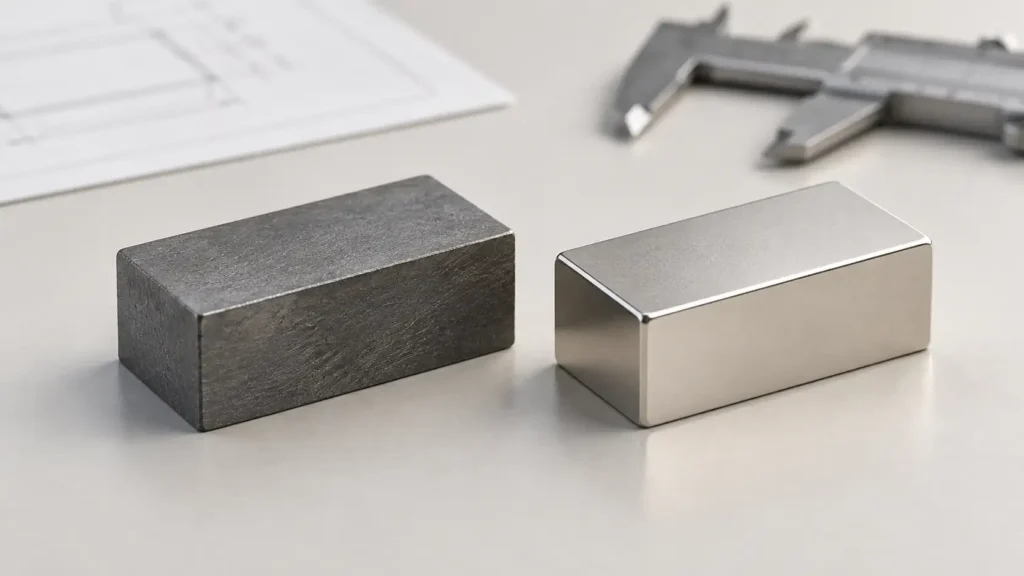
Test 4 Samarium Cobalt vs Neodymium Magnets: How to Choose for an Application
Room-temperature strength can make neodymium look like the obvious choice. But…
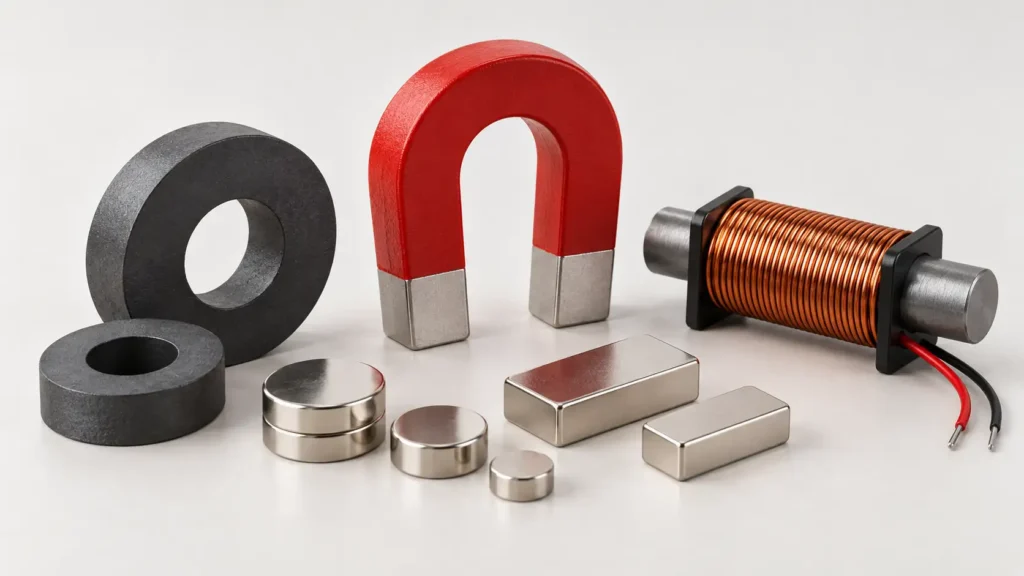
A neodymium magnet is usually an NdFeB magnet: a permanent magnet made from neodymium, iron and boron. The family name, or a grade label by itself, does not specify how a finished part will perform. To evaluate one, compare the exact supplier data with the part’s geometry, required output, temperature and environment.
This article is a first-pass orientation, not a grade-by-grade selection guide. For detailed grade-code and datasheet explanations, see Magnetways’ Magnet Grades guide.
NdFeB names the neodymium-iron-boron material family. It includes magnets made by more than one manufacturing route, including sintered and bonded forms. The U.S. Department of Energy describes tradeoffs across properties such as coercivity and maximum energy product, as well as operating temperature, weight and cost. In its assessment, bonded NdFeB generally has lower energy product and is typically used when complex shapes matter; sintered NdFeB is typically used in harsher or higher-temperature conditions. These are DOE’s broad tendencies, not rules for every grade or design. Read the DOE assessment.
A manufacturing-route label alone does not establish the part’s dimensions, output or suitability. Those require data for the proposed part and its design conditions.
A supplier’s data may include several magnetic properties. Three useful terms are:
Arnold’s catalogue lists Br, HcB, HcJ and (BH)max for its own grades. Those entries show the kind of grade-specific data in that catalogue; they are not specifications for another manufacturer’s magnets. See Arnold’s NdFeB catalogue.
These material properties are not the same as a field reading at a sensor or the pull force of a finished assembly. The result depends on the part and how it is measured. Arnold’s measurement guide explains the effects of sample geometry, temperature, measurement method and self-demagnetizing conditions. For a design decision, request the exact maker’s data and test conditions, then check the output that matters in the intended assembly.
Do not infer a universal operating temperature from “NdFeB” or a grade family. Arnold’s catalogue gives temperature-related data by grade and notes that properties vary with factors including alignment during compaction, magnet size and shape. Ask for data for the exact grade and part, and state the operating temperature, duration and acceptable performance change.
Unprotected NdFeB can oxidize and corrode in the presence of oxygen and water vapor, according to the DOE assessment. Protection depends on the coating system and the exposure; a coating name alone does not establish suitability. Describe the actual environment and ask the supplier to confirm the proposed part’s coating and supporting evidence.
Before comparing parts or requesting a quote, define:
This short checklist cannot replace a procurement specification; it helps reveal which design inputs still need answers.
If you have a drawing or defined requirements, send them through Magnetways’ Contact page. The page accepts project inquiries and drawings; the magnet’s specifications and suitability still need to be confirmed for the application.
Custom neodymium magnets are made-to-order magnets tailored to meet specific requirements for shape, size, strength, magnetic orientation, and coating, differentiating them from standard, off-the-shelf neodymium magnets.
Neodymium offers the highest available magnetic strength among all permanent magnet materials, making it ideal for applications requiring compact size and maximum magnetic force. It’s also versatile in manufacturing, allowing for a wide range of custom shapes and sizes.
Yes, custom neodymium magnets can be manufactured in virtually any shape and size, including discs, blocks, rings, cylinders, arcs, and complex geometries tailored to specific application needs.
Room-temperature strength can make neodymium look like the obvious choice. But…
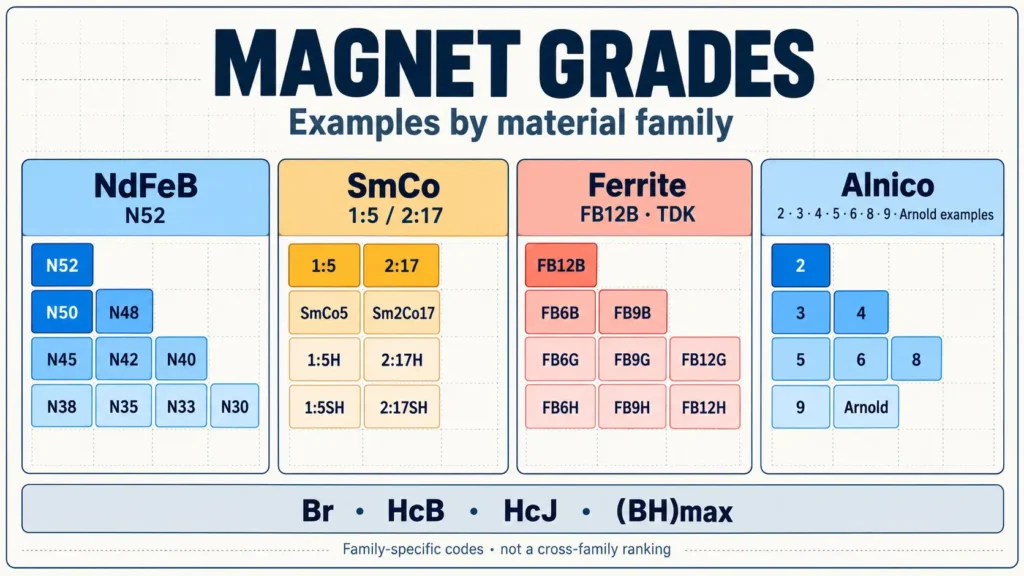
A grade on a magnet quote tells you something about the…
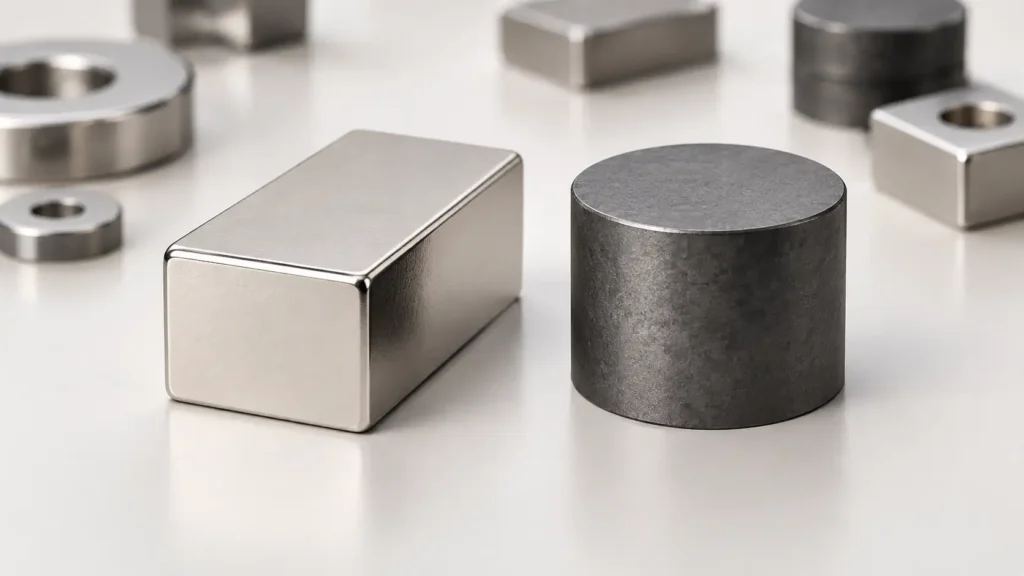
Neodymium magnets are rare-earth magnets. "Rare earth" is the broader category;…
A neodymium magnet is also a rare-earth magnet and a permanent…