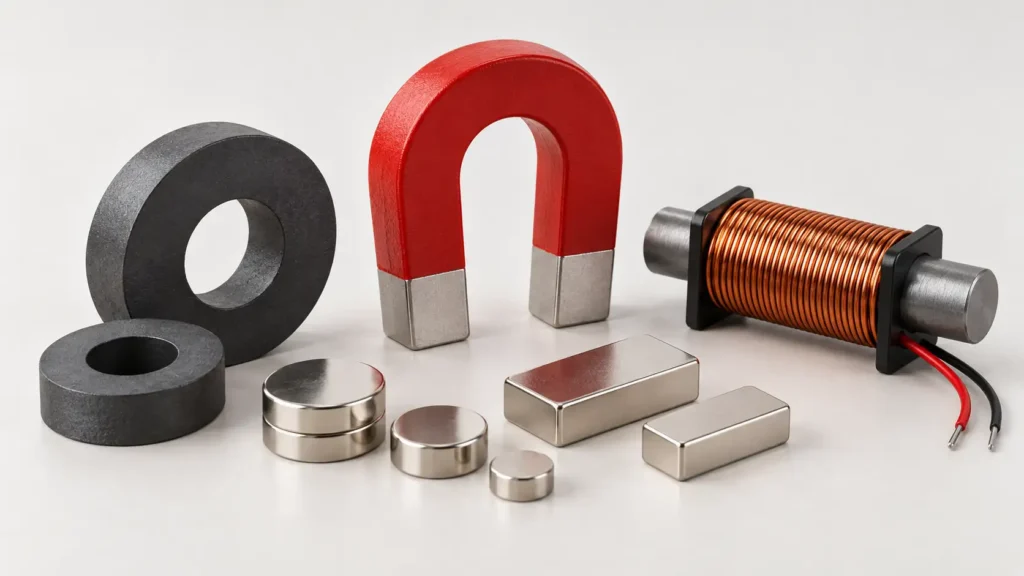
A neodymium magnet is also a rare-earth magnet and a permanent magnet. Those labels describe different things, which is why a list of “magnet types” can become confusing.
Start with how the magnetic field is maintained: permanent magnets retain magnetization, temporary magnets respond to an applied field, and electromagnets produce a field using electric current. Then, for permanent magnets, compare the material families: neodymium, samarium-cobalt, Alnico, and ferrite.
The main types of magnets
These categories answer a useful first question: what keeps the magnet working?
| Category | What maintains the magnetic field? | What the label tells you |
|---|---|---|
| Permanent magnet | The material retains magnetization after the magnetizing field is removed. | It can maintain a field without a continuous supply of electric current. |
| Temporary or induced magnet | An applied magnetic field magnetizes a material that does not strongly retain that magnetization. | Its magnetic behavior depends on the field applied to it. |
| Electromagnet | Electric current flowing through a coil of wire produces the field. | Current is the source of the operating field. |
Permanent-magnet materials are also called magnetically hard. Materials used for temporary magnetization are called magnetically soft. Here, hard and soft describe how the materials retain magnetization. They do not refer to physical hardness. MIT’s magnetic-materials overview explains this distinction.
The categories overlap in an electromagnet with a soft magnetic core. Current flows through the coil, and the resulting field magnetizes the core. “Electromagnet” describes the whole device; “soft magnetic material” describes its core. Removing current removes the current-generated field, but the core may retain some magnetization.
For a project discussion, first establish whether the design calls for a persistent field or a field supplied by current. That helps frame the next conversation about materials and construction.
Four permanent-magnet materials
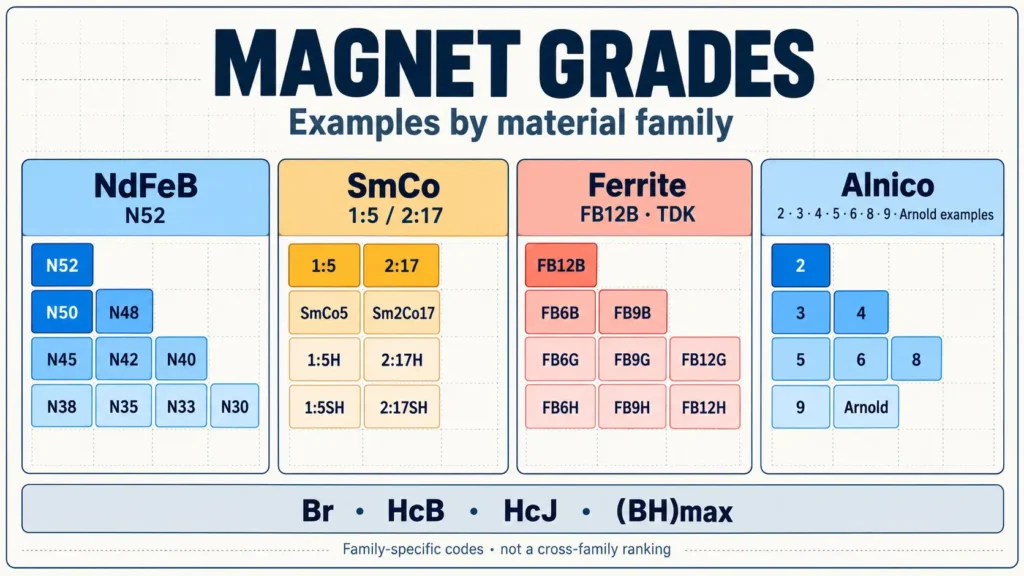
Within the permanent-magnet category, material names give you another way to sort the options. The four families covered here are neodymium-iron-boron, samarium-cobalt, Alnico, and hard ferrite, also called ceramic magnets.
Rare-earth magnets is a grouping that includes neodymium and samarium-cobalt magnets. It is not a fifth material family alongside them. A specification that says “rare-earth magnet” therefore leaves an important choice open.
Neodymium magnets: NdFeB
NdFeB stands for neodymium-iron-boron. Its high maximum energy product, a measure associated with magnetic performance per unit volume, can enable compact, lightweight components. The proposed grade still needs to meet the application’s temperature and demagnetization requirements.
If space is a major constraint, investigate NdFeB grades against the actual requirement.
Samarium-cobalt magnets: SmCo
Samarium-cobalt is the other rare-earth family covered here. The U.S. Department of Energy’s (DOE) rare-earth permanent-magnet assessment identifies its better resistance to demagnetization at elevated temperatures compared with NdFeB, alongside NdFeB’s energy-product advantage.
Include SmCo in a temperature-focused comparison. Give the supplier actual operating conditions; “high temperature” leaves too much open.
Alnico magnets
Alnico takes its name from aluminum, nickel, and cobalt. It is a permanent-magnet family outside the two rare-earth groups above. The DOE’s 2015 assessment describes Alnico as more thermally stable than NdFeB: its magnetic properties are less affected by temperature changes.
That gives Alnico a reason to enter a temperature-focused comparison, but does not establish a universal operating limit or prove suitability for a particular assembly. Ask how the proposed Alnico grade performs across your required temperature range.
Ferrite or ceramic magnets
For permanent magnets, look for the term hard ferrite. “Ceramic magnet” is another name used for this family; it is separate from NdFeB, SmCo, and Alnico.
The DOE’s 2015 critical-materials assessment describes ferrite as offering lower magnetic strength and lower production cost than NdFeB. Treat that as a material tradeoff, rather than a current price quote. To compare an actual ferrite option, request a design that meets your magnetic requirement within the available space, then compare its price and fit with the alternatives.
Which properties matter for your application?
“Strong” is too vague to be a purchasing specification. Use these questions to make the comparison useful:
- Magnetic output and space: What result must the magnet achieve, and how much room is available? Maximum energy product helps compare materials, but does not by itself predict a finished part’s performance.
- Coercivity: How resistant is the material to being demagnetized by an opposing magnetic field?
- Operating temperature: What temperature conditions must the selected grade withstand?
- Weight and cost: What constraints must the complete solution meet?
Compare candidate parts against the same requirements. A material comparison made at room temperature cannot settle a selection for a different operating environment.
Keep the material family and the specific grade separate in your notes. The family narrows the discussion; the grade and component proposal give you something concrete to assess.
What to specify before choosing a magnet
Prepare a short requirements note before asking a supplier to recommend a material. Include:
- The job: Describe what the magnet must do and how you will judge success. If you have a target force or field, include its units and where it must be achieved.
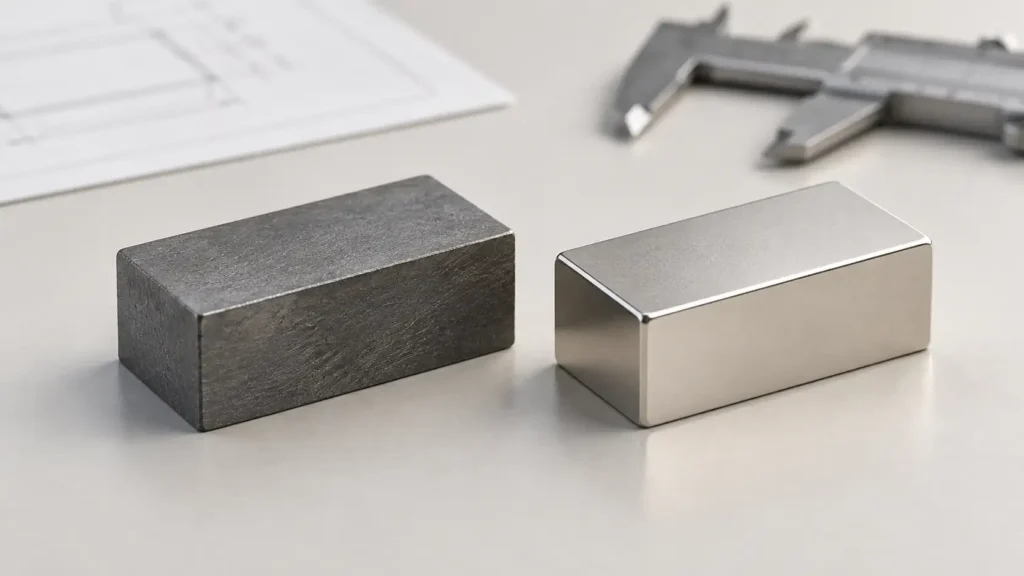
- Available space: Supply a drawing or dimensions, plus any restrictions on shape, mounting, or weight.
- Temperature conditions: Give the expected operating range and any brief temperature peaks you know about.
- Surroundings: Describe nearby equipment or magnetic fields, and any exposure to moisture, chemicals, or other relevant conditions. Let the supplier assess what these mean for the proposed part.
- Project constraints: State the quantity, budget, schedule, and any requirements the finished assembly must satisfy.
For example, imagine you are specifying a magnetic catch. “Use a strong neodymium magnet” leaves the intended result unclear. A more useful inquiry describes the required holding force, the surfaces and separation involved, the space available, operating conditions, and how the catch will be mounted. Include a drawing and ask which material and grade the supplier proposes against those requirements.
You do not need to arrive with the material choice settled. Arrive with a defined job, and ask for the evidence that the proposed magnet can do it.