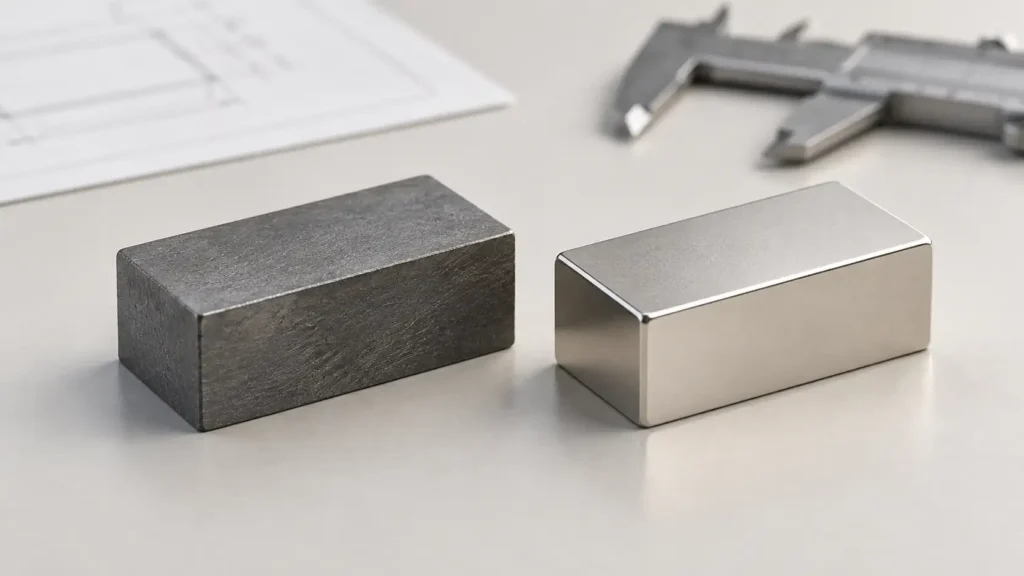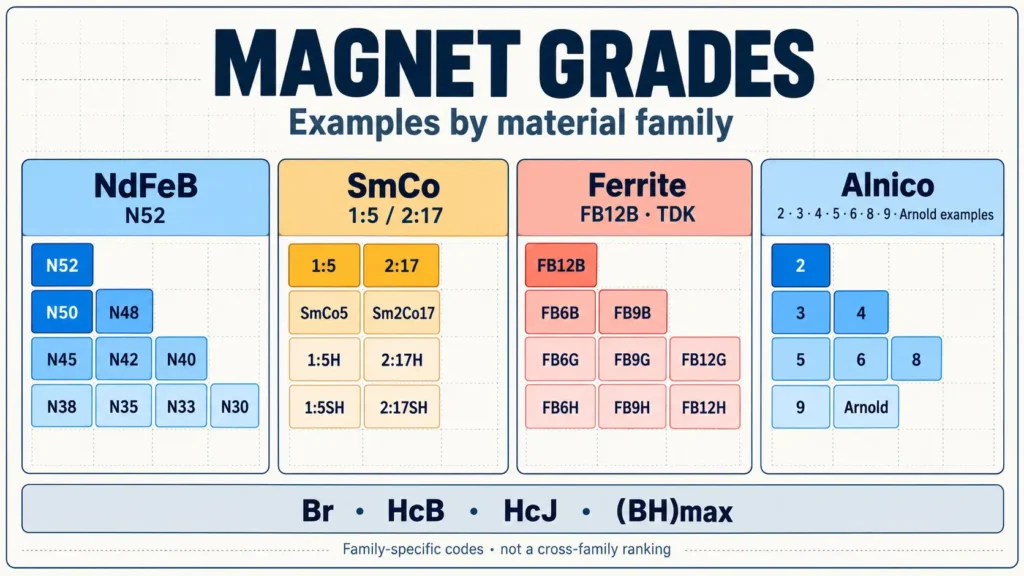
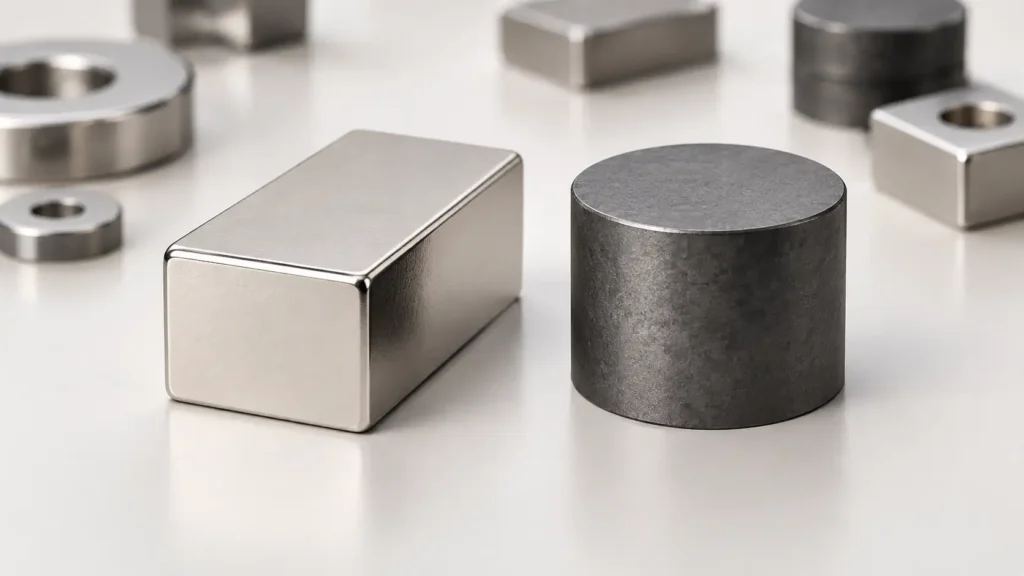
Neodymium magnets are rare-earth magnets. “Rare earth” is the broader category; neodymium-iron-boron (NdFeB) is one family within it, and samarium cobalt (SmCo) is another. The useful comparison is usually NdFeB versus SmCo, not neodymium versus rare earth as if they were separate categories.
At a family level, the U.S. Department of Energy’s 2022 supply-chain assessment reports higher maximum energy product for NdFeB at temperatures up to about 180°C, while SmCo is more resistant to demagnetization at higher temperatures. Those are starting points, not a verdict for every magnet: grade, geometry, magnetic circuit, temperature, and environment all affect whether a particular part will work. DOE’s assessment explains these tradeoffs and their limits.
The short answer: neodymium is a rare-earth magnet
A rare-earth magnet is a permanent magnet made using rare-earth elements. NdFeB magnets use neodymium (often alongside other elements), iron, and boron; SmCo magnets use samarium and cobalt. Both belong to the rare-earth magnet category, but they are different material families with different tradeoffs.
That category-versus-member distinction clears up the apparent “neodymium or rare earth?” choice. If a drawing, product page, or supplier quote says only “rare-earth magnet,” ask which family and grade it means. The category name alone does not tell you enough to compare performance.
NdFeB vs SmCo: the practical differences
| Comparison point | NdFeB (neodymium) | SmCo (samarium cobalt) |
|---|---|---|
| Maximum energy product | The DOE report describes NdFeB as having a higher maximum energy product in its comparison, at temperatures up to about 180°C. | Lower than NdFeB in that comparison. |
| Resistance to demagnetization at higher temperatures | The DOE comparison says SmCo is more resistant; the operating limit still depends on the NdFeB grade. | More resistant to demagnetization at higher temperatures in the DOE comparison. |
| Corrosion and protection | Oxidation can be a concern for unprotected NdFeB; coating and exposure conditions matter. | No like-for-like corrosion conclusion is established here; evaluate the specified material and environment. |
| Price | No current comparable quote set is available. | No current comparable quote set is available. |
The energy-product comparison describes how much magnetic energy a material can provide for a given volume under specified conditions. It helps explain why NdFeB is often investigated when a design needs substantial magnetic output in limited space. It does not by itself predict the force or performance of a finished assembly; dimensions, air gap, magnetic circuit, and operating conditions matter too. The DOE report’s comparison is a family-level technical assessment, not a test of your proposed parts.
A magnet’s maximum recommended operating temperature is grade-dependent, and the rating is not a promise that the magnet will retain its required performance in every assembly. The DOE assessment lists different limits for different NdFeB grades, so a generic cutoff cannot settle a real design. SmCo’s stronger resistance to demagnetization at elevated temperatures makes it a candidate to evaluate when that condition matters, but the selected SmCo grade still needs to meet the application’s requirements.
The corrosion comparison is unresolved. The DOE report notes that oxygen and water vapor can oxidize the rare-earth metal fraction in NdFeB and describes coatings used to protect it. The coating, its integrity, and the environment need to be considered together; a coated magnet is not automatically suitable for every exposure. The DOE report coating discussion describes NdFeB protection, but does not establish a like-for-like corrosion advantage for SmCo.
Price is also unresolved without comparable quotes. A meaningful comparison needs the same market, quantity, dimensions, grade requirements, coating, and delivery basis. A broad claim that one family is always cheaper would outrun the evidence and may not describe the parts you are actually buying.
How to compare magnets for a real application
Start with the part’s requirements, not the family name. For a supplier or design review, assemble:
- The exact grade and data sheet. Confirm the grade on both sides of the comparison, including any temperature designation and the manufacturer’s stated limits.
- The magnetic requirement. Specify the needed field, force, or other measurable outcome, plus the geometry, air gap, and magnetic circuit. “Stronger” is not a complete requirement.
- The operating temperature. Define the expected range and duration, then check the grade’s data against the assembled part and its conditions.
- The environment and coating. Describe moisture, oxygen, or other relevant exposure and identify the proposed coating and its condition.
- A comparable cost basis. Compare quotes for equivalent quantities and specifications, including coating and delivery terms.
Two terms on magnet data sheets help make the comparison more precise. Maximum energy product is a measure of magnetic energy density and is commonly used to compare how much magnetic output a material can provide relative to its volume. Coercivity describes resistance to demagnetization: in plain terms, how much opposing magnetic field it takes to reduce the magnet’s magnetization. Neither number alone predicts finished-part performance, so read them alongside the other grade data and the assembly requirements.
As a first screening rule, investigate NdFeB when compact magnetic output is a central constraint. Include SmCo in the comparison when resistance to demagnetization at higher temperatures is a design concern. Then verify the exact grades, part geometry, environment, and cost on a like-for-like basis. Without those details, the material-family comparison can narrow the questions, but it cannot select the finished magnet.