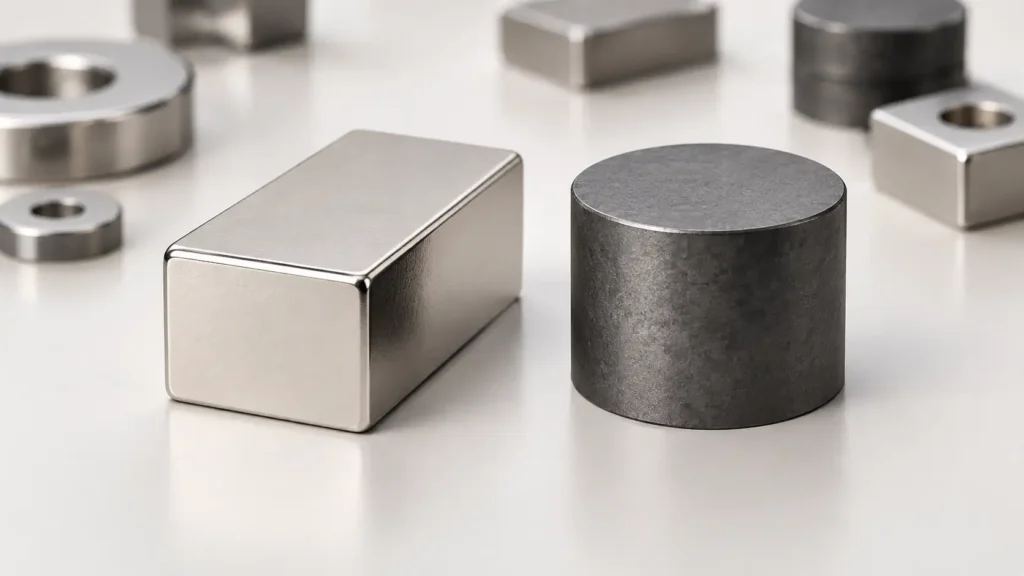
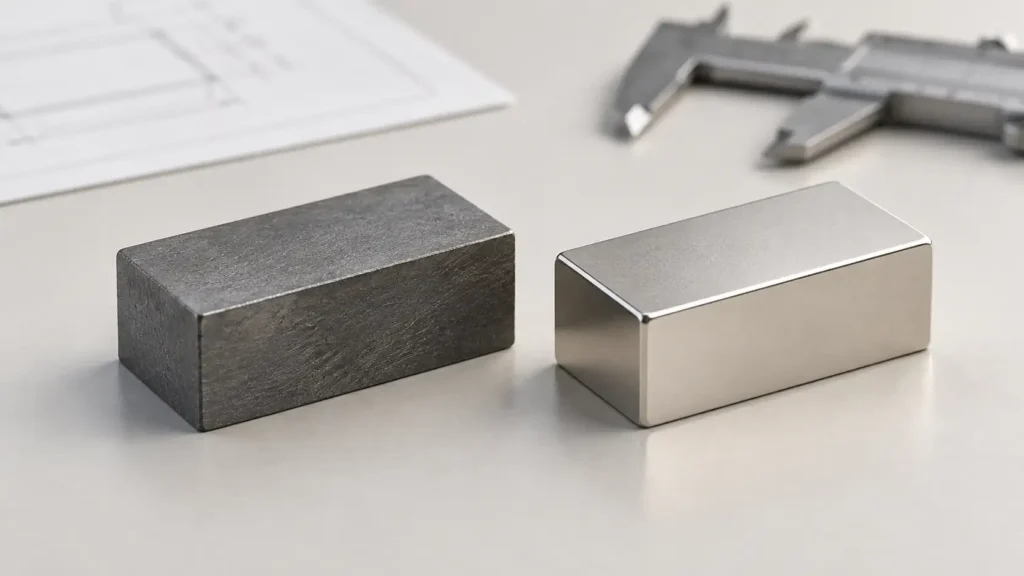
Room-temperature strength can make neodymium look like the obvious choice. But if a magnet runs hot or sees an opposing magnetic field, the design question changes: will the chosen grade keep enough demagnetization margin in this geometry and assembly?
At the material-family level, neodymium-iron-boron (NdFeB) offers higher maximum energy product in the U.S. Department of Energy’s comparison up to about 180°C, while samarium cobalt (SmCo) is more resistant to demagnetization at higher temperatures. That is a starting point, not a universal crossover temperature or a part recommendation. Start with the magnet’s actual hot-spot temperature and magnetic circuit, then compare named grades, environment, handling, and like-for-like cost. The DOE assessment describes the family-level tradeoff and the limits of treating any single property as a selection rule.
Here, “neodymium” means NdFeB magnets. For the short distinction between NdFeB and other rare-earth magnet families, see Neodymium Magnets vs Rare Earth Magnets. The live destination should be checked before publication.
NdFeB vs SmCo at a glance
| Decision factor | NdFeB (neodymium) | SmCo (samarium cobalt) | What the comparison can tell you |
|---|---|---|---|
| Magnetic output per material volume | Higher maximum energy product in the DOE comparison up to about 180°C. | Lower than NdFeB in that scoped comparison. | NdFeB merits evaluation when compact magnetic output matters. Energy product alone does not predict force or finished-part performance. |
| Resistance to demagnetization at higher temperatures | Grade and application dependent. | DOE describes greater family-level resistance than NdFeB at higher temperatures. | SmCo merits evaluation when elevated-temperature demagnetization is a concern. No single family label supplies a usable temperature limit. |
| Grade-level temperature behavior | Properties and stated limits vary by grade. | Properties and stated limits vary by grade. | Compare the exact grades’ data at the expected operating conditions. |
| Corrosion and protection | Arnold advises protective finishes for humid use in its NdFeB product context; suitability depends on the material and exposure. | A DOE/OSTI project description reports good corrosion resistance for sintered Sm-Co materials, but it is not a matched test or coating rule. | Evaluate the specified magnet, finish, and environment. Neither family name settles the requirement. |
| Mechanical handling | No matched comparative fracture evidence in this source set. | Sintered Sm-Co is described as brittle in a DOE/OSTI project report. | Ask about the exact part and assembly method; this does not establish a universal comparative failure rate. |
| Price and installed cost | No comparable quote set available. | No comparable quote set available. | Cost winner is unknown. Compare equivalent parts and commercial terms. |
The DOE comparison is a family-level guide, while the coating and grade examples from Arnold’s NdFeB guidance apply to that supplier’s listed products. The DOE/OSTI Sm-Co project description concerns the materials and work described there; it does not qualify a particular commercial grade or finished assembly.
1. Start with the magnet’s hot spot and demagnetizing conditions
Use the temperature inside or at the magnet in the assembled application, not just ambient temperature. Identify the expected hot spot, how long it lasts, the duty cycle, and any temperature changes. A component’s local magnet temperature can differ from the surrounding air, so an ambient reading by itself may not describe the magnet’s exposure.
Compare the grade’s demagnetization curves at relevant temperatures with the proposed dimensions and shape, magnetic circuit, hot spot, opposing fields, and duty cycle. The DOE report explains why coercivity, maximum energy product, and operating temperature are tradeoffs to consider together, but it does not calculate the operating point of your specific part. A generic maximum operating temperature or family-level statement cannot replace that assessment. SmCo belongs on the shortlist when its higher-temperature resistance to demagnetization may address a real constraint; the grade and assembled design still need to satisfy the requirement.
2. Compare output using named grades, not family labels
Maximum energy product (often written as BHmax) describes magnetic energy density under specified material conditions. It helps explain why NdFeB can be attractive when a design needs high magnetic output from a compact volume. It is not a direct measurement of pull force, air-gap field, or performance in a finished assembly.
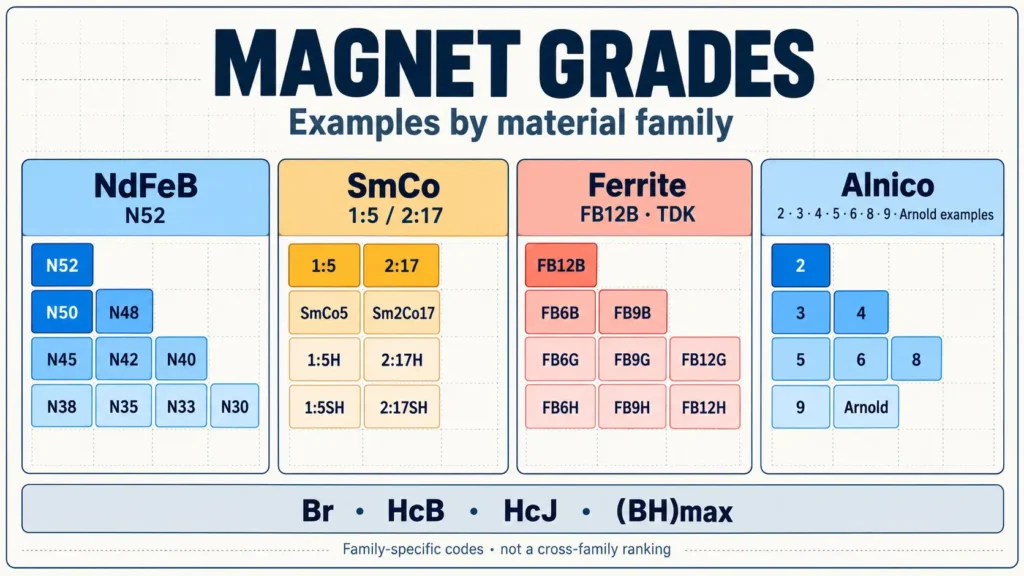
A grade name narrows the comparison, but does not complete it. Manufacturers publish properties and limits for particular grades, and those values vary within each family. For example, Arnold’s NdFeB grade table lists different maximum-temperature values across its named N35-series grades. Those are supplier-listed examples, not universal NdFeB limits or a matched comparison with an SmCo part.
Ask for the properties needed to assess the stated output in the proposed dimensions and magnetic circuit. Compare equivalent design requirements and the supplier’s data under relevant conditions; do not infer that a higher room-temperature energy product automatically yields a better working magnet.
3. Match the environment to the magnet and its protection
Describe the actual exposure: humidity or water, chemicals, temperature, and any other conditions relevant to the part. For NdFeB, Arnold’s product guidance discusses protective coatings for humid applications and notes that coating effectiveness depends in part on base-material quality. That is supplier guidance for its product context, not proof that every NdFeB magnet needs the same finish.
For SmCo, the DOE/OSTI project description reports good corrosion resistance for the sintered materials it discusses. It does not provide a like-for-like corrosion test against a specified NdFeB grade, coating, and exposure. Do not read “corrosion resistant” as “immune,” or as evidence that a particular assembly needs no protection.
Specify the environment and ask the supplier to identify the proposed base material, finish, and relevant qualification data. Include seams, edges, and other exposed features of the finished part in that discussion where they apply.
4. Plan for handling and assembly
Mechanical behavior belongs in the choice because a magnet is made, transported, and assembled as a part. A DOE/OSTI report on sintered Sm-Co identifies brittleness as a manufacturing and shape challenge. That supports taking chipping and fracture into account for the specific part; it does not quantify a comparative failure rate against NdFeB magnets.
Before selecting a design, describe how the magnet will be machined or finished, clamped, bonded, inserted, and loaded in service, as applicable. Ask the supplier for handling and assembly guidance for the exact geometry. Avoid using family-level claims to assume either that a part is mechanically robust or that it will fail.
5. Compare the same commercial requirement
The available evidence does not establish a universal price winner. A quote for one family is not comparable with another if the grade, dimensions, output requirement, coating, quantity, delivery terms, or other supplied work differ.
Compare current quotations on the same basis: a defined grade and part, equivalent magnetic requirement, finish, quantity, delivery point and terms, plus any assembly or qualification included in the offer. Consider the cost of the specified solution as quoted; the packet contains no matched price set from which to rank NdFeB and SmCo.
What to request before specifying a grade
Give suppliers the same application information and ask for:
- Named grade and current data sheet for each candidate, including the conditions attached to listed properties and limits.
- Magnet dimensions and magnetic-circuit assumptions, including the required output and relevant air gaps.
- Temperature profile at the magnet, including hot-spot temperature, duration, duty cycle, and temperature changes.
- Demagnetization data at relevant temperatures, plus an assessment of the grade’s operating point under the application’s geometry and opposing fields.
- Environmental details and proposed protection, including the exposure and finish for the actual part.
- Handling and assembly constraints, along with supplier instructions relevant to the proposed geometry and process.
- Comparable quotation terms for equivalent parts, quantities, finishes, delivery, and any included assembly or qualification.
Keep the comparison tied to the assembled application. If the candidates do not use equivalent dimensions or meet the same output requirement, a side-by-side material figure or price does not answer which option meets the design.
The decision in one sentence
Investigate NdFeB when compact magnetic output is a priority; include SmCo when the DOE-described higher-temperature demagnetization resistance or relevant corrosion evidence addresses a defined constraint. Then compare the exact grade in the actual geometry, magnetic circuit, temperature profile, environment, and assembly before specifying a part. For a fuller SmCo family overview, see Samarium Cobalt Magnets; recheck that live destination before publication.